

- Details
- Hits: 2057
- Description: Walk around the world by a French globetrotter
- Alias-Pseudonimo-Pseudonyme: -
- Nationality-Nazionalità-Nationalité: France, Francia
- Birth/death-Nascita/morte-Naissance/mort: -
- Means of transport-Mezzo di trasporto-Moyen de transport: On foot, A piedi, A pied
- Geographical description-Riferimento geografico-Référence géographique: Around the World, Giro del mondo, Tour du monde
- Additional references-Riferimenti complementari-Références complémentaires: Wanganui Chronicle, Volume L, Issue 12143, September 17, 1907, Page 3.
- Inscriptions-Iscrizioni-Inscriptions: 40000 kilomètres à pied. Henri Mosse globe trotter T.C.F. Français
Around the World For a Wager
Hale and tanned, but marked by scars made by cruel fetters in a Russian prison, Henri Mosse arrived in San Francisco recently from the Far East on the French steamer Amiral Juareguiberry en route to Paris striving to win a strange race.
The steamer reached port on a Saturday night, but was held in quarantine until the next morning on account of the presence on board of a large number of Japanese steerage passengers, who were bound for Vancouver, B.C. Mosse and an Englishman now in India are the sole surviving competitors in a race around the world, and both are nearing the end of their long journey. One or the other will win a prize of 50,000 francs by arriving first in Paris.
Mosse was chauffeur in the French capital when the Sportsmen's Club, of London, suggested to the Touring Club, of Paris, that each organisation should furnish four men and send them out on a competitive tour of the world, without funds, except two francs each, the men to travel in pairs, an Englishman with a Frenchman.
The four pairs were to go over different routes. After all preliminaries had been arranged, the start was made on June 14, 1904, and the limit for the world tour was fixed for June 14, 1906. Two of the men started by the way of Africa, two by way of America and the remaining couple by way of Asia Minor. Mosse and his English companion took the Asia Minor route, and got along well together until Constantinople was reached, in July, 1904, when the Englishman, George Moss, succumbed to an attack of fever. The Frenchman, Mosse, came on alone, and had many hairbreadth escapes. At Odessa, on the Black Sea, he was suspected of being a Japanese spy, and for 25 days was kept in chains in a foul prison. His ankles still bear the scars of the irons. Upon being released he passed on afoot and by sea to India, and still later to China.
In the district of Bing Sam, in the interior of China, Mosse was captured by highwaymen and robbed of £4, all the money he had. But he was well treated by the bandits, who offered him a Chinese wife if he should care to remain a while with them.
Mosse chose to keep moving, and he tramped along until he reached the coast, where he took ship for Japan. At Yokohama he joined the Amiral Juareguiberry and worked his way thence to San Francisco. He must leave the vessel there, for it is a condition of the contest that he shall travel overland whenever it is possible. Mosse has been kept posted by the French Club as to his competitors. Letters he has received at various points along his strange course have informed him that the couple going by the African route were murdered by treacherous Abyssinians on the desert, who cut off the heads of the Frenchman and Englishman. The two men who went by way of Australia both took sick and died in the same hospital of a fever. The Frenchman who went by way of America was lost in China, his companion proceeding to India, where he was at last accounts plodding along.
The victory in the long race rests between Mosse and the Englishman in India, the only survivors of the contest. The winner will receive a prize of 50,000 francs, and there is no second prize. That Mosse has visited all the strange places he talks about is proven by the autographs and seals of officials in the countless out-of-the-way places all the way from Paris to Yokohama.
Wanganui Chronicle, Volume L, Issue 12143, 17 September 1907, Page 3.
- Details
- Hits: 15470
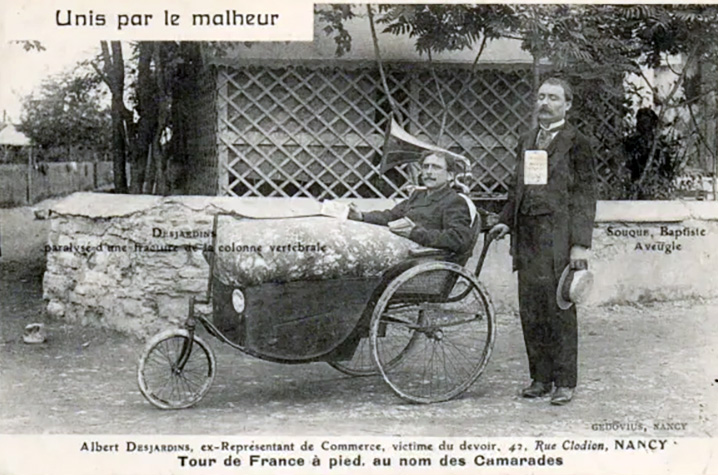
- Description: Albert Desjardins and Mougin Félix are two disabled globetrotters who undertook a tour of France
- Alias-Pseudonimo-Pseudonyme: -
- Nationality-Nazionalità-Nationalité: France, Francia
- Birth/death-Nascita/morte-Naissance/mort: -
- Means of transport-Mezzo di trasporto-Moyen de transport: On foot, A piedi, A pied
- Geographical description-Riferimento geografico-Référence géographique: France, Francia
- Inscriptions-Iscrizioni-Inscriptions: Unis par le malheur, Albert Desjardins, victime du devoir, père de famille, tour de France à pied, au nom des camarades français, Mougin Félix, aveugle
- Details
- Hits: 19352
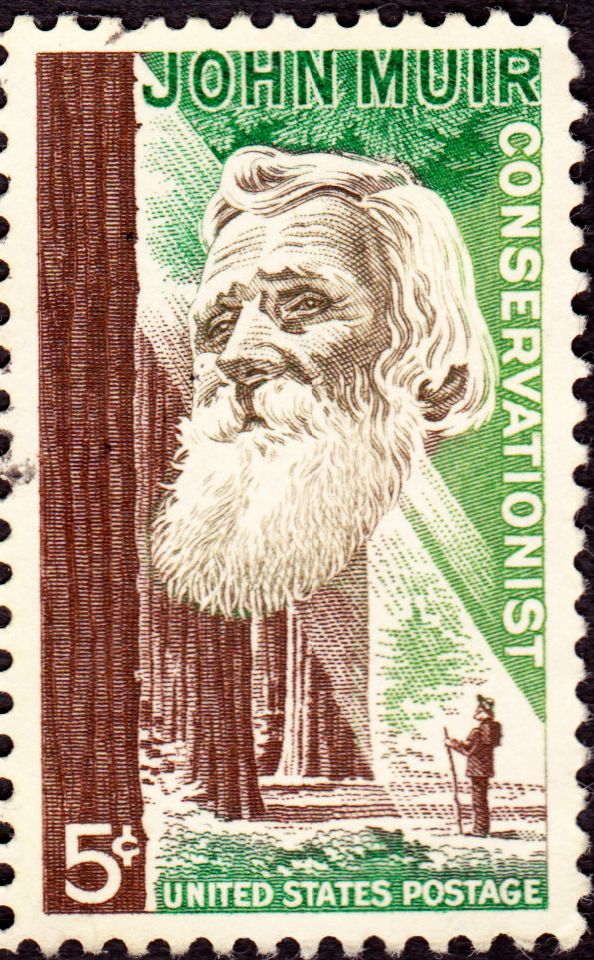
- Description: John Muir, a renowned American naturalist and conservationist, undertook numerous journeys that took him through vast regions of the United States and the world. Throughout his life, Muir explored the Sierra Nevada in California, visited Alaska, traveled to Africa, South America, and various places in Europe. Among his most significant journeys was his over 1'000-mile walk through the Sierra Nevada in 1868, which allowed him to deeply understand the unique ecosystem of this region. Throughout his life, Muir actively promoted nature conservation and was one of the founders of the United States' National Park System
- Alias-Pseudonimo-Pseudonyme: -
- Nationality-Nazionalità-Nationalité: Scottish, Scozzese, Ecossais
- Birth/death-Nascita/morte-Naissance/mort: 1838-1914
- Means of transport-Mezzo di trasporto-Moyen de transport: On foot, A piedi, A pied
- Geographical description-Riferimento geografico-Référence géographique: Americas, Americhe, Amérique
- Internet: http://en.wikipedia.org/wiki/John_Muir
- Wikidata: https://www.wikidata.org/wiki/Q379580
- Additional references-Riferimenti complementari-Références complémentaires: Muir, John. A Thousand-Mile Walk to the Gulf. Boston: Houghton Mifflin Company, 1916.
John Muir, Earth-planet, Universe. These words are written on the inside cover of the notebook from which the contents of this volume have been taken. They reflect the mood in which the late author and explorer undertook his thousand-mile walk to the Gulf of Mexico a half-century ago. No less does this refreshingly cosmopolitan address, which might have startled any finder of the book, reveal the temper and the comprehensiveness of Mr. Muir s mind. He never was and never could be a parochial student of nature. Even at the early age of twenty-nine his eager interest in every aspect of the natural world had made him a citizen of the universe.
.jpg)
- Details
- Hits: 17490
- Description: Jerome Murif was the first to travel the Adelaide – Darwin route in 1897. Supported by a German bicycle manufacturer, Electra, he crossed the continent motivated by the fact that no man (or woman) had done before him. He described his adventures, which nearly cost him his life, in the book "From Ocean to Ocean"
- Alias-Pseudonimo-Pseudonyme: -
- Nationality-Nazionalità-Nationalité: Australia
- Birth/death-Nascita/morte-Naissance/mort: 1863-1926
- Means of transport-Mezzo di trasporto-Moyen de transport: Bike, Bicicletta, Vélo
- Geographical description-Riferimento geografico-Référence géographique: Australia
- Internet: https://en.wikipedia.org/wiki/Jerome_J._Murif
- Wikidata: https://www.wikidata.org/wiki/Q30323853
- Additional references-Riferimenti complementari-Références complémentaires: Murif J. J., From ocean to ocean: across a continent on a bicycle, an account of a solitary ride from Adelaide to Port Darwin, Melbourne, George Robertson & Co., 1897.
- Details
- Hits: 15114
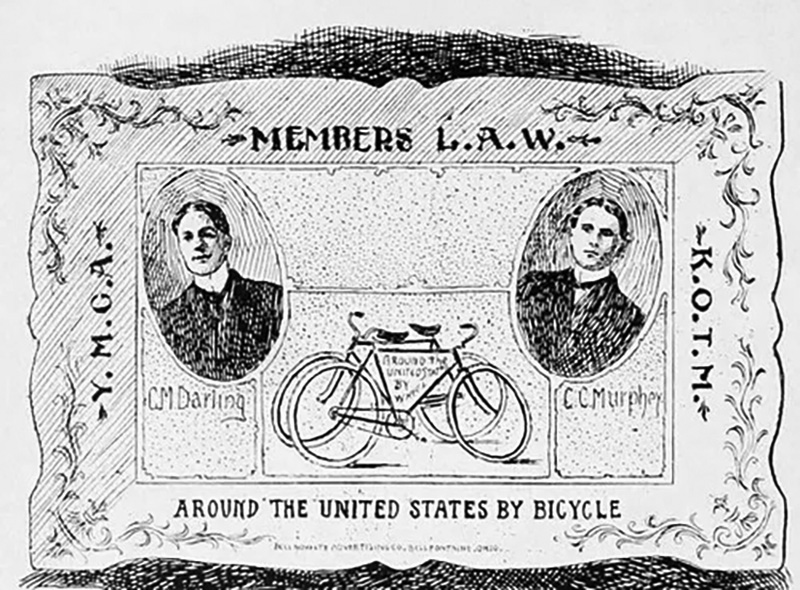
- Description: Clarence M. Darling and Claude C. Murphey departed from the Hotel Otsego in Jackson on May 2, 1904. After traveling 13'407 miles and a year and three months, they returned to the Michigan town having completed a tour of the United States following a bet. They lost the bet in Vermont, where they were unable to meet the 'financial' clauses of the wager: "The conditions were that they were to start on this long journey penniless, while on the trip they were neither to beg, work, borrow, nor steal, all the expenses of the tour to be met by the profits resulting from the sale of an aluminum card-receiver or ash-tray"
- Alias-Pseudonimo-Pseudonyme: -
- Nationality-Nazionalità-Nationalité: USA
- Birth/death-Nascita/morte-Naissance/mort: -
- Means of transport-Mezzo di trasporto-Moyen de transport: Bike, Bicicletta, Vélo
- Geographical description-Riferimento geografico-Référence géographique: USA
- Additional references-Riferimenti complementari-Références complémentaires: Murphey C., Around the United States by bicycle, Detroit, Press of Raynor & Taylor, 1906.
Clarence M. Darling and Claude C. Murphey, age 19 and 20 respectively, left Jackson, Michigan, on May 2, 1904, to make a trip by bicycle through every state and territory within the boundary lines of the United States proper, namely, fortv-five states, four territories, and the District of Columbia. The trip was the result of a wager. Upon the success of the tour a purse of five thousand dollars would be won by the two contestants providing that they lived up to all the terms and stipulations of the wager. The conditions were that they were to start on this long journey penniless, while on the trip they were neither to beg, work, borrow, nor steal, all the expenses of the tour to be met by the profits resulting from the sale of an aluminum card-receiver or ash-tray, a fac-simile of which is given on one of the following pages.
Murphey, Claude Charles. Around the United States by Bicycle. Detroit: Press of Raynor & Taylor, 1906.
- Details
- Hits: 15456
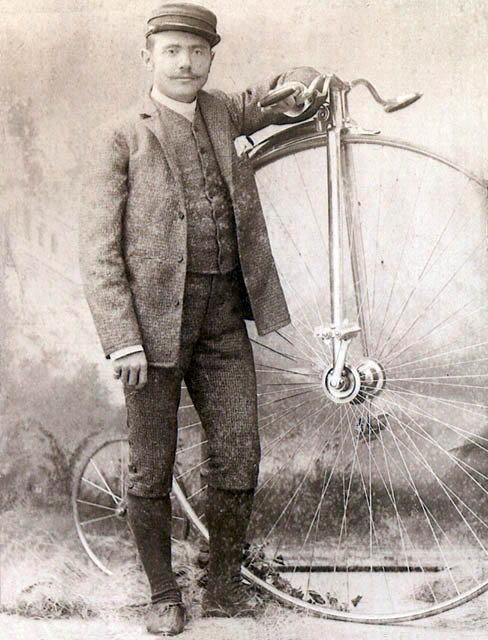
- Description: In 1887, George Nellis was the third cyclist to complete a crossing of the United States
- Alias-Pseudonimo-Pseudonyme: -
- Nationality-Nazionalità-Nationalité: USA
- Birth/death-Nascita/morte-Naissance/mort: 1865-1948
- Means of transport-Mezzo di trasporto-Moyen de transport: Bike, Bicicletta, Vélo
- Geographical description-Riferimento geografico-Référence géographique: USA
- Internet: https://www.thewheelmen.com/sections/americanjourneys/goldengate/george_nellis.pdf
- Additional references-Riferimenti complementari-Références complémentaires: Hayes K. J., An American cycling odyssey, 1887, University of Nebraska, 2002.
In 1887 George Nellis became the third person to ride across the United States, from Herkimer, New York to San Francisco, shaving several weeks off Thomas Stevens’ time, thus becoming the first to “race across the United States.” Throughout this account, Hayes reports on the state of bicycle touring in the late nineteenth century.

- Details
- Hits: 604
- Description: Siegfried Neuhaus was a German motorcyclist from Halberstadt. On 11 September 1934 he departed Berlin with Hans Reichardt as pillion rider on a Harley-Davidson, on a round-the-world journey completed in approximately one year. The two met the Polish couple Bujakowski and Korolec-Bujakowska in Baghdad, having chosen an almost identical route. Hans Reichardt may have left the journey in Siam (Thailand), reportedly having been commissioned by the King of Siam to manage a hotel. Neuhaus continued alone to Shanghai, then Japan, then crossed the United States from Los Angeles to New York, returning by ship to Copenhagen and by motorcycle to Halberstadt, arriving around August 1935. All souvenirs, photographs and the Harley-Davidson were lost when Halberstadt was destroyed in the final days of World War II. Only a handful of photographs survived, which Neuhaus reportedly kept in his breast pocket throughout his life
- Alias-Pseudonimo-Pseudonyme: -
- Nationality-Nazionalità-Nationalité: Germany, Germania, Allemagne
- Birth/death-Nascita/morte-Naissance/mort: -
- Means of transport-Mezzo di trasporto-Moyen de transport: Motorbike, Motocicletta, Moto
- Geographical description-Riferimento geografico-Référence géographique: Around the World, Giro del mondo, Tour du monde
- Internet: https://berndtesch.de
.jpg)
- Details
- Hits: 15572
- Description: Richard E. New, starting from Akron (OH, USA), was known by the motto 'Legless Motor Cycle Rider.' Mr. New sold postcards and photographs enriched with anecdotes describing his handicap. After falling from a hot air balloon for 1'800 feet, he lost sight in one eye, broke his spine in two places, and shattered his feet and legs so severely that amputation was necessary. Between 1915 and 1920, he traveled 100'000 miles on the roads of North America
- Alias-Pseudonimo-Pseudonyme: Legless Motor Cycle Rider
- Nationality-Nazionalità-Nationalité: USA
- Birth/death-Nascita/morte-Naissance/mort: -
- Means of transport-Mezzo di trasporto-Moyen de transport: Motorbike, Motocicletta, Moto
- Geographical description-Riferimento geografico-Référence géographique: USA
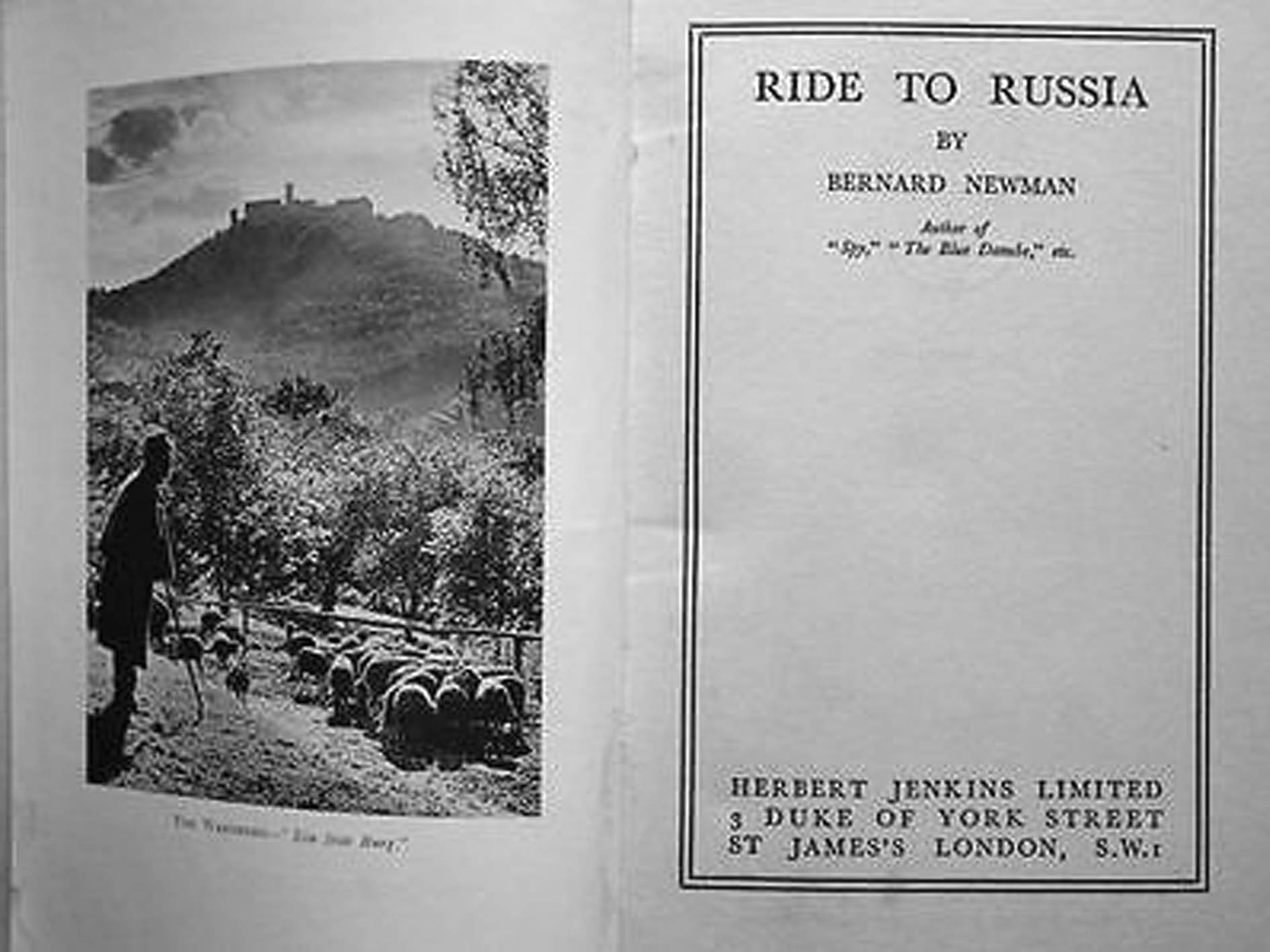
- Details
- Hits: 14638
- Description: Numerous motorcycle journeys undertaken in the 1930s
- Alias-Pseudonimo-Pseudonyme: -
- Nationality-Nazionalità-Nationalité: -
- Birth/death-Nascita/morte-Naissance/mort: 1897-1968
- Means of transport-Mezzo di trasporto-Moyen de transport: Motorbike, Motocicletta, Moto
- Geographical description-Riferimento geografico-Référence géographique: -
- Internet: https://en.wikipedia.org/wiki/Bernard_Newman_(author)
- Wikidata: https://www.wikidata.org/wiki/Q4893468
- Additional references-Riferimenti complementari-Références complémentaires: Newman B., Ride to Russia, London, H. Jenkins Limited, 1938.