

- Details
- Hits: 182
- Description: Bartłomiej “Bart” Jezierski is a Polish long-distance walker, social activist and graduate of the University of Glasgow. He is the founder of Peace Walking, a humanitarian walking initiative established in 2016, built around a series of expeditions known as the European Walks for Peace and Freedom (EWPF). His journeys are undertaken without financial resources, without sponsorship and without external support, relying on endurance, minimalism and the hospitality of strangers. He has accumulated approximately 18,000 km on foot across 39 countries in Europe. The first expedition, EWPF 2016, covered approximately 3,000 km from Bielsko-Biała, Poland, to Athens, Greece, in 75 days, raising funds for UNICEF UK. The second, EWPF 2017/18, covered nearly 6,000 km from Jelenia Góra to Lisbon over 352 days, including the Camino de Santiago (Northern Way), raising funds for Glasgow Children’s Hospital Charity. The third, EWPF 2021/22, was the longest: approximately 8,000 km over 14 months through central, western and southeastern Europe, raising funds for Polish Humanitarian Action, accompanied for part of the route by a stray dog named Bruna who crossed multiple countries on foot. A shorter Glasgow-London walk of approximately 700 km was completed in 2020
- Alias-Pseudonimo-Pseudonyme: Bart, Peace Walking
- Nationality-Nazionalità-Nationalité: Poland, Polonia, Pologne
- Birth/death-Nascita/morte-Naissance/mort: -
- Means of transport-Mezzo di trasporto-Moyen de transport: On foot, A piedi, À pied
- Geographical description-Riferimento geografico-Référence géographique: Europe, Europa
- Internet: https://en.wikipedia.org/wiki/Peace_Walking
- Wikidata: https://www.wikidata.org/wiki/Q141353634
- Additional references-Riferimenti complementari-Références complémentaires: “Niesamowita pasja pana Bartłomieja.” Pomorska.pl. https://pomorska.pl/niesamowita-pasja-pana-bartlomieja-z-nowego-podrozuje-pieszo-po-europie-bez-pieniedzy/ar/c7-16331007

- Details
- Hits: 659
- Description: In 2006, aged 41, Paul Staso ran 3,260 miles (5,247 km) coast-to-coast across the United States solo, from Oregon to Delaware, covering 15 states in 108 days at an average of 30 miles per day. He pushed a 65-pound jogging stroller carrying gear, food and water throughout. The run was undertaken to keep a promise made to a group of elementary school children, and served to promote youth health and fitness. He subsequently ran solo across Germany, Alaska and Montana. In 2011 he became the first person to run solo across the Mojave Desert
- Alias-Pseudonimo-Pseudonyme: -
- Nationality-Nazionalità-Nationalité: USA
- Birth/death-Nascita/morte-Naissance/mort: -
- Means of transport-Mezzo di trasporto-Moyen de transport: On foot, A piedi, À pied
- Geographical description-Riferimento geografico-Référence géographique: Various, Diversi, Différents
- Internet: https://paulstaso.blogspot.com
- Multimedia: https://www.youtube.com/user/pacetrek
- Details
- Hits: 816
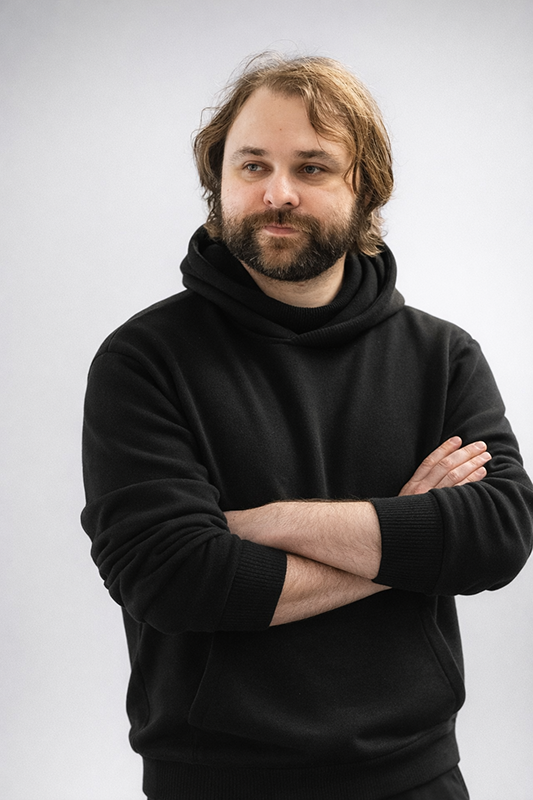
- Description: Timur Khusyainov is a Russian cultural traveller, researcher and academic. He has travelled across 19 countries and 44 regions of the Russian Federation, frequently leading expeditions. He heads the Postal Heritage Laboratory "Pochtovoe" and participates in the PostVenture project, recognised with the national "Crystal Compass" award in 2021. He has contributed to cultural projects including "Pishu Tebe" and the "Russian Samovar" circumnavigation flashmob, connecting people through postcards and travel letters. In 2022 he received the National Award "Russian Traveler" in the "Traveler-Researcher" category
- Alias-Pseudonimo-Pseudonyme: -
- Nationality-Nazionalità-Nationalité: Russia, Russia, Russie
- Birth/death-Nascita/morte-Naissance/mort: -
- Means of transport-Mezzo di trasporto-Moyen de transport: Various, Vari, Divers
- Geographical description-Riferimento geografico-Référence géographique: Various, Vari, Divers
- Internet: http://husyainov.ru
- Details
- Hits: 985
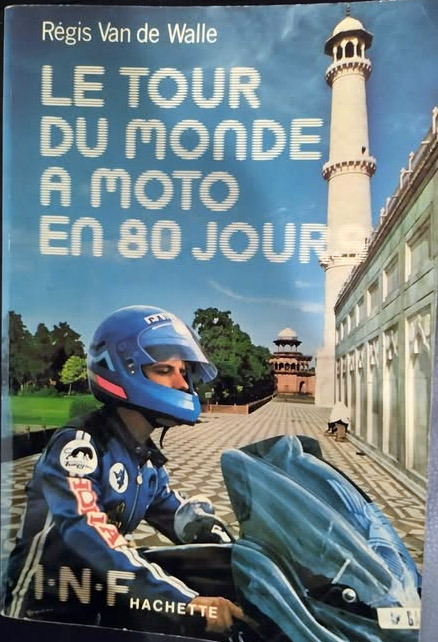
- Description: Régis van de Walle was a French motorcyclist and author who completed a round-the-world motorcycle journey in 80 days, recounted in his book Le tour du monde à moto en 80 jours, published by Hachette/Moto-journal in 1979. No further biographical details are documented in available sources
- Alias-Pseudonimo-Pseudonyme: -
- Nationality-Nazionalità-Nationalité: France, Francia
- Birth/death-Nascita/morte-Naissance/mort: -
- Means of transport-Mezzo di trasporto-Moyen de transport: Motorbike, Motocicletta, Moto
- Geographical description-Riferimento geografico-Référence géographique: Around the World, Giro del mondo, Tour du monde
- Additional references-Riferimenti complementari-Références complémentaires: Van de Walle, Régis. Le tour du monde à moto en 80 jours. Paris: Hachette/Moto-journal, 1979.
- Details
- Hits: 893
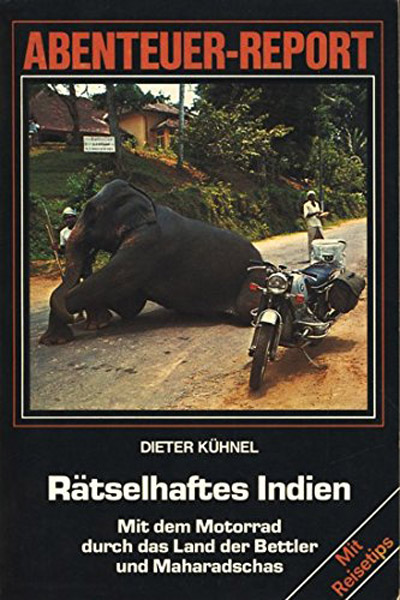
- Description: Dieter Kühnel was a German long-distance motorcyclist and author. As part of a world tour on a BMW R 60/5 600 cc, he rode from India through Burma, Thailand, Malaysia, Borneo, Sumatra, Java, Celebes, the Moluccas, Irian Jaya and Papua New Guinea. He authored two books on his journey: Rätselhaftes Indien: Abenteuer-Report mit dem Motorrad durch das Land der Bettler und Maharadschas and Motorrad-Odyssee: Von Burma durch die Inselwelt Südostasiens, published by Frederking & Thaler, Munich, in 1989
- Alias-Pseudonimo-Pseudonyme: -
- Nationality-Nazionalità-Nationalité: Germany, Germania, Allemagne
- Birth/death-Nascita/morte-Naissance/mort: -
- Means of transport-Mezzo di trasporto-Moyen de transport: Motorbike, Motocicletta, Moto
- Geographical description-Riferimento geografico-Référence géographique: Asia
- Additional references-Riferimenti complementari-Références complémentaires: Kühnel, Dieter. Rätselhaftes Indien. Munich: Frederking & Thaler, 1989. Kühnel, Dieter. Motorrad-Odyssee: Von Burma durch die Inselwelt Südostasiens. Munich: Frederking & Thaler, 1989.
- Details
- Hits: 887
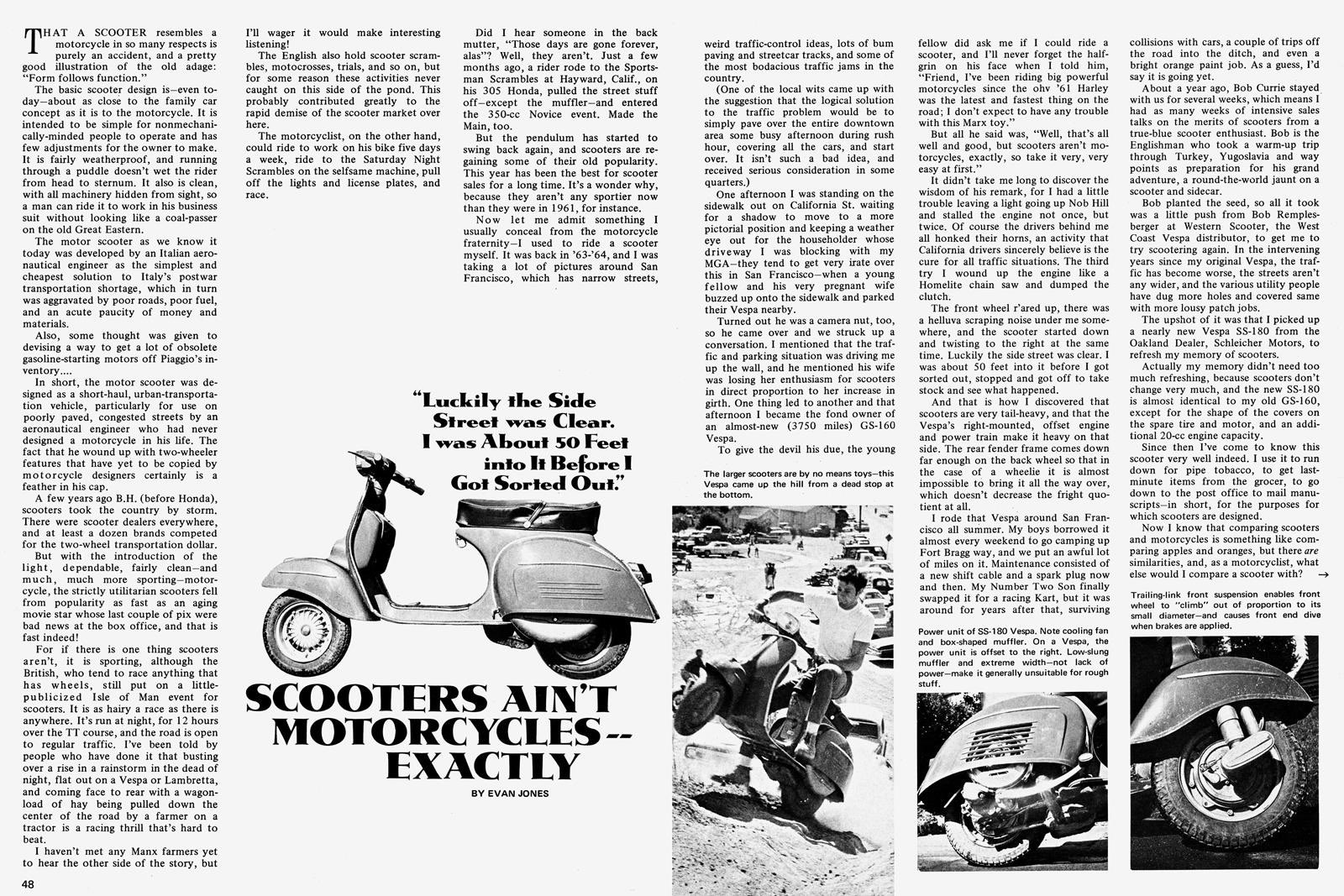
- Description: Robert Frank Currie (26 April 1918 - 25 July 1988) was an English motorcycling journalist, road tester, magazine editor and author, described by colleagues as "The Walking Encyclopaedia of Motor Cycling History." Between 1965 and 1969 he completed a round-the-world journey on a Vespa Super Sport 180 cc with a Watsonian Bambini sidecar, fitted with long-range fuel tanks and modified lighting. He covered approximately 59,000 km (37,000 miles) through central Europe, Hungary, Yugoslavia, Greece, Turkey, Syria, Lebanon and Jordan - turned back at the Iraqi border - before returning to the UK and shipping to North America, riding from New York through Canada and across the United States to Mexico
- Alias-Pseudonimo-Pseudonyme: -
- Nationality-Nazionalità-Nationalité: UK, Inglese, Anglais
- Birth/death-Nascita/morte-Naissance/mort: 1918-1988
- Means of transport-Mezzo di trasporto-Moyen de transport: Vespa
- Geographical description-Riferimento geografico-Référence géographique: Around the World, Giro del mondo, Tour du monde
- Internet: https://en.wikipedia.org/wiki/Bob_Currie
- Wikidata: https://www.wikidata.org/wiki/Q23688748
- Additional references-Riferimenti complementari-Références complémentaires: "Scooters Ain't Motorcycles." Cycle World, June 1969.
- Details
- Hits: 942
- Description: Siska and Zdenek Polanka were Czechoslovak motorcyclists. In 1955 they completed a round-the-world journey on a Jawa-CZ 350. The journey was documented in a five-page report published in Revue du Moteur Tchecoslovaque (issue 7/1956). On his return, Zdenek Polanka rode for the Czechoslovak team in the International Six Days Trial, winning the event in 1956. Further details of their route and itinerary are not documented in available sources
- Alias-Pseudonimo-Pseudonyme: -
- Nationality-Nazionalità-Nationalité: Czech Republic, Repubblica Ceca, République Tchèque
- Birth/death-Nascita/morte-Naissance/mort: -
- Means of transport-Mezzo di trasporto-Moyen de transport: Motorbike, Motocicletta, Moto
- Geographical description-Riferimento geografico-Référence géographique: Around the World, Giro del mondo, Tour du monde
- Internet: https://berndtesch.de
- Additional references-Riferimenti complementari-Références complémentaires: "Tour de monde avec des Jawa-CZ 350." Revue du Moteur Tchecoslovaque, n. 7, 1956.
- Details
- Hits: 978
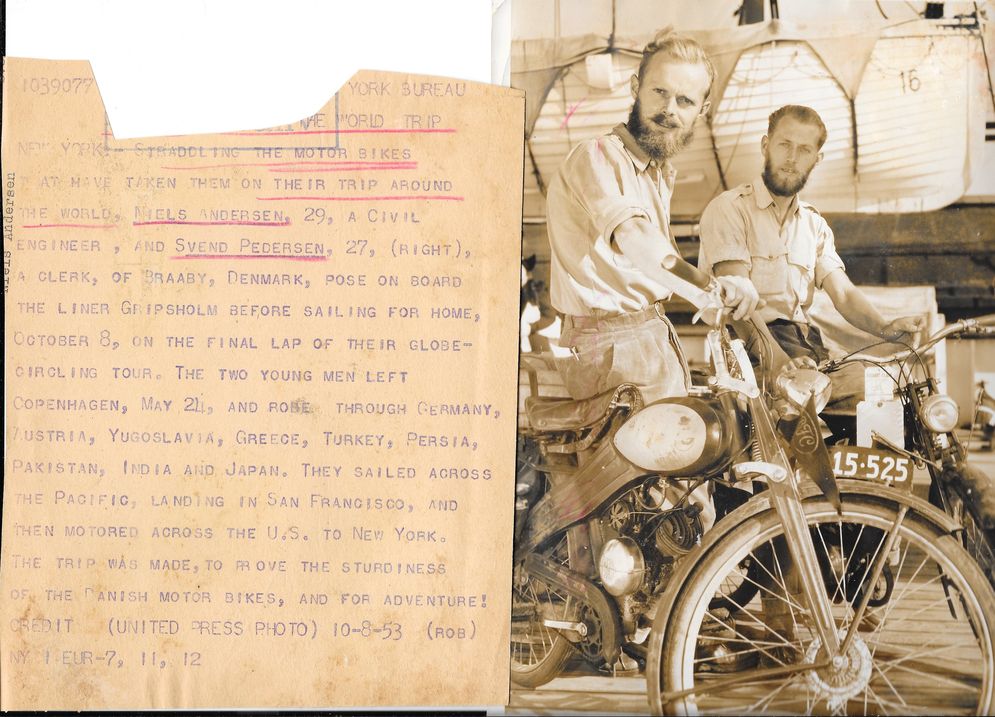
- Description: Niels Andersen (born 1934, Denmark) and Svend Pedersen (born 1936, Denmark) were a Danish civil engineer and a clerk from Braaby, Denmark. Between 21 May and approximately 8 October 1953 they completed a round-the-world journey on Danish motorcycles, covering Europe (Denmark, Germany, Yugoslavia, Greece), Asia (Turkey, Persia, Pakistan, India, then by ship to Japan), and North America (by ship to San Francisco, then by motorcycle to New York), returning by ship to Denmark. The journey was undertaken to demonstrate the reliability of Danish motorcycles
- Alias-Pseudonimo-Pseudonyme: -
- Nationality-Nazionalità-Nationalité: Denmark, Danimarca, Danemark
- Birth/death-Nascita/morte-Naissance/mort: -
- Means of transport-Mezzo di trasporto-Moyen de transport: Motorbike, Motocicletta, Moto
- Geographical description-Riferimento geografico-Référence géographique: Around the World, Giro del mondo, Tour du monde
- Internet: https://berndtesch.de

- Details
- Hits: 694
- Description: Siegfried Neuhaus was a German motorcyclist from Halberstadt. On 11 September 1934 he departed Berlin with Hans Reichardt as pillion rider on a Harley-Davidson, on a round-the-world journey completed in approximately one year. The two met the Polish couple Bujakowski and Korolec-Bujakowska in Baghdad, having chosen an almost identical route. Hans Reichardt may have left the journey in Siam (Thailand), reportedly having been commissioned by the King of Siam to manage a hotel. Neuhaus continued alone to Shanghai, then Japan, then crossed the United States from Los Angeles to New York, returning by ship to Copenhagen and by motorcycle to Halberstadt, arriving around August 1935. All souvenirs, photographs and the Harley-Davidson were lost when Halberstadt was destroyed in the final days of World War II. Only a handful of photographs survived, which Neuhaus reportedly kept in his breast pocket throughout his life
- Alias-Pseudonimo-Pseudonyme: -
- Nationality-Nazionalità-Nationalité: Germany, Germania, Allemagne
- Birth/death-Nascita/morte-Naissance/mort: -
- Means of transport-Mezzo di trasporto-Moyen de transport: Motorbike, Motocicletta, Moto
- Geographical description-Riferimento geografico-Référence géographique: Around the World, Giro del mondo, Tour du monde
- Internet: https://berndtesch.de