
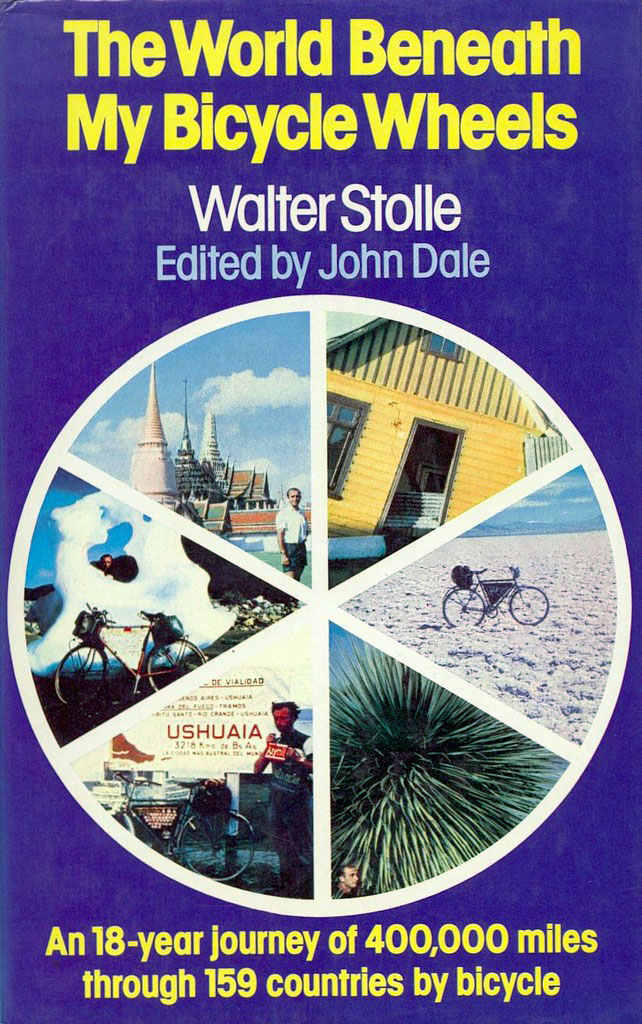
Walter Stolle's Bicycle Saga, or Around the World in 18 Years. When he was a teenager, Walter Stolle got a crazy idea. “I decided,” he recalls, “that I would make the longest journey ever on a bike.” He did. It covered 400,000 miles—the equivalent of 16 trips around the world—took him to 159 countries and lasted 18 years.
Born 50 years ago to Austrian parents in Czechoslovakia’s German-speaking Sudetenland, Walter expected to run the family’s tree nursery. World War II changed all that. “In 1945,” he reflects sadly, “we lost everything. I remember the cold war—the Berlin blockade. I wanted to get away from allot it.”
He went to England, became naturalized and prepared five years for his epic journey. “I read all kinds of travel books,” he says, “and I learned languages.” Stolle speaks Spanish, English, French, German, Portuguese, Dutch and Afrikaans. He got his legs in shape by cycling from Land’s End in the south of England to John o’Groats in northern Scotland.
When he set out on Jan. 25, 1959, Stolle traveled light. Half of his 44-pound pack was photographic equipment. He crossed the oceans on freighters, liners and planes and stayed in youth hostels and inexpensive hotels. Five of his bikes were stolen and six wore out. He was robbed 231 times—twice on one day in Jakarta, Indonesia. He was never ill—although he was gored by a gazelle in Africa—and managed to donate blood in 12 countries. Most satisfying about the cycling, he says, was “going downhill.”
Stolle financed the journey by giving some 2,600 lectures and slide shows at $100 a performance. Some of the income went to fix his 1,000 flats.
He has now come to rest in London, where he is staying with a lady friend, working on a book about his experiences and making plans to buy a three-bedroom bungalow in Spain.
Looking back, Stolle believes that he has achieved something far more satisfying than the wealth his family had before the war. “What I have learned and seen,” he says, “nobody can take away from me.”
http://people.com/archive/walter-stolles-bicycle-saga-or-around-the-world-in-18-years-vol-7-no-2/
Longest Jouney By Bicycle (Individual)
The greatest mileage amassed in a cycle tour was more than 646’960 km (402’000 miles), by the itinerant lecturer Walter Stolle (CZE) from 24 January 1959 to 12 December 1976. He visited 159 countries, starting out from Romford in Essex, UK.
Guinness Book of World Records 2015
From Nowhere, Going Everywhere.
I was rootless and a bike was an ideal medium for me. In my Czechoslovakian homeland, peace had been restored with a vengeance. After the war I had never been permitted to return to Ketten, to the house my father had built or to the Sudetenland. Under a Czechoslovakian Army guard, my widowed mother and younger brother Erich had been assembled with other Sudeten Germans on the same green where I had learned to cycle. They had been stripped of their valuables and then forcibly marched to the German border and expelled.
I was, at twenty, homeless. Homeless I remained in a way although Britain offered me work, sanctuary and eventually nationality. I always had a job, food, a roof over my head and plenty of savings. But I never set up home, somewhere that could compare with the one in Ketten from which I was exiled.
My rootless condition inspired my view of the world from my favourite vantage point, the saddle of a bike. What might have been fantasies to others became genuine ambitions to me. The most recurring of these was a simple logical progression which prompted some people to say I was becoming obsessed.
If I could cross one country, I could cross a Continent. If I could cross a Continent, I could encircle the World. As logic it was faultless. As a plan of action, flimsy. But on 23 January 1959, it was about to become reality as I pedalled through the gates of the Ford Motor Company at Dagenham on the eastern fringe of London. I had arrived two hours early to put in overtime. The night was frosty and every breath turned white on contact with the air. I slid my bike into the bike rack, clocked in, and set to work.
I was a coremaker; few jobs could have been more removed from my own trade, that of a skilled nurseryman. It was a measure of my determination that I had sacrificed my work as a horticulturalist in order to shovel and shape sand into moulds and take home a Ford pay packet.
My own spare time was sacrificed too as I enrolled myself at Goldsmith College to study Spanish. I attended the beginners' course in the first half of the evening, ate a cafe snack immediately after it and was back behind my desk for the intermediate course — much to the teacher's consternation. I brushed up my wartime French and taught myself Portuguese from text books. At the same time I began to prowl round Dagenham library, pouncing on the shelves marked Travel. I borrowed one volume penned at the turn of the century by three Englishmen. Like me, they were cyclists and I identified with them. They told how they rode around the world — first to the Far East, by ship to California and eventually returning to Britain via New York. [link to Fraser]
On my own world map I traced their route. No doubt conditions were tougher in 1900. But I knew this — around the world would not be good enough for me. I intended to tour the world, from north to south, east and west and country by country.
At Goldsmith, I exchanged smiles with a young Spanish girl who was learning English. Soon we were able to talk and joke with each other. Eventually Maria and I became unofficially engaged, and our conversation progressed to wedding plans. But I remained adamant with her as well as myself. I explained my ambitions, saying the trip would take three, maybe five, years.
She was small and pretty with a soft maternal complexion. Sometimes she waved her hands in the air as if I were a naughty child. “No, Walter,” she used to say, her voice full of scepticism, “you will never, never leave.”
For a brief period it seemed as if Maria's words might well come true. I had intended to set off in the autumn of 1958. The first delay happened when I crashed badly in a London fog. Then I had my radio stolen and had to wait for a replacement. Then sentiment persuaded me to stay for Christmas and leave on New Year's Day. Even that date had passed and I still turned up for my shift at Ford every night. Now it was nine o'clock on the Friday evening and I had just said goodbye to Maria for the last time.
In the early hours of 24 January, I put down my tools and queued for my final pay packet. At seven o'clock that morning a horn blared, dispatching a section of the workforce home. With an air of finality I laid down my tools for the last time. Outside the cold air prompted me to pull on some gloves before venturing onto the road. Astride my saddle I pedalled among the throng of men heading towards their hot breakfasts and a day in bed.
At the first roundabout my front tyre touched some black ice and skidded from under me. More surprised than stunned, I found myself lying on my side on the white-frosted tarmac. A group of figures crossed on foot towards me out of the darkness.
“Press, Mr. Stolle,” one announced. “I'm from the Romford Times."
From my prone position I glanced upwards to be instantly blinded by a white barrage of popping flash bulbs. I rose to my feet still dazzled, remounted and pedalled away.
Stolle W., The world beneath my bicycle wheels, London, Pelham, 1978, pp. 15-21.