
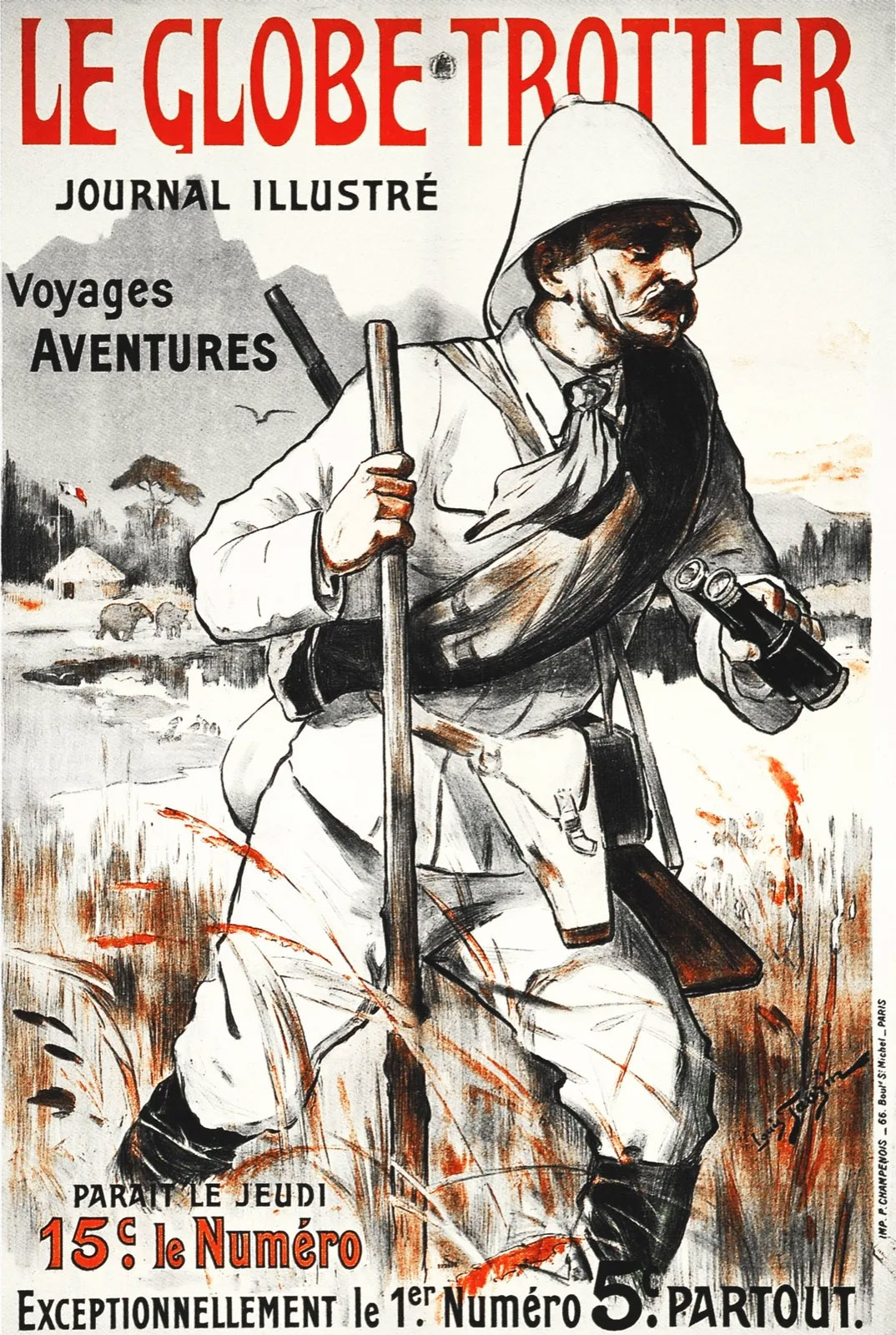
How can the phenomenon of globetrotters be studied? Which sources can be used to reconstruct the stories of those who travelled the world with limited means? This article presents the methodology and challenges of a twenty-year research project devoted to travellers who, since the mid-nineteenth century, have helped turn travel into a democratic form of exploration.
Who is a globetrotter?
A globetrotter is a person who travels around the world for extended periods, often with limited means and without commercial purposes. Within the Museum of Travel, the term is not used in a restrictive sense. It does not refer only to those who have completed a declared round-the-world journey or a demonstrative feat, but includes all figures who, through travel, have contributed to shaping a collective imagination of the world.
The repertoire therefore includes:
- Explorers and travellers
- Long-distance cyclists and walkers
- Writers and diarists
- Missionaries, adventurers, reporters
- Contemporary figures who have redefined the meaning of global mobility
What unites these individuals is not only the distance travelled, but the cultural impact of their journeys: the ability to transform travel experience into narrative, testimony, knowledge, myth, or symbol.
Paradoxically, this perspective also includes fictional globetrotters and those who did not fully accomplish what they claimed. Even when a journey is incomplete, exaggerated, or constructed in literary form, it still contributes to shaping representations, aspirations, and models of mobility. The imaginary of travel does not arise solely from kilometres actually travelled, but also from stories told or imagined. Fictional characters also play an important role: one may think of the impact of Phileas Fogg on generations of travellers.
From this perspective, the globetrotter is прежде all a historical and cultural figure rather than a purely geographical one. Every documented journey - real, incomplete, or narrative - becomes part of a network of representations that helps shape the idea of the “world” across different periods.
The figure of the globetrotter is primarily grounded in:
- Adventure and personal discovery
- A challenge against oneself or against time
- Autonomy in means and route choices
Sources and methodology
This catalogue is the result of over twenty years of research conducted in libraries and archives. The sources used are heterogeneous and, whenever possible, cross-checked to assess their reliability:
- Postcards and materials produced by the globetrotters themselves
- Historical archives of newspapers and periodicals
- Travel diaries and published accounts
- Specialized bibliography and digital resources
- Archival materials
The challenges
The subject is fluid and difficult to define. Who can truly be considered a globetrotter? How can criteria of “certification” be established? Many micro-histories prove unreliable: in-depth investigations have often revealed elements of partial or complete fiction. Information found on historical postcards, for example, must be treated with caution, as it often reflects commercial strategies or self-financing practices.
Selection criteria
The initiatives included on the site share the following characteristics:
- Spontaneity and absence of commercial intent
- An autonomous project with a clearly defined beginning and end
- Impact on the collective imagination, assessed through contemporary media coverage, reprints of travel accounts, and reception in public discourse
- Originality in approach or execution
The timeframe of reference
The catalogue mainly focuses on the period 1850–1945. The year 1850 marks the beginning of a new phase:
- Thomas Cook develops the first international package tours
- The Universal Exhibitions emerge (London, 1851)
- Travel literature expands significantly with authors such as Mark Twain and Robert Louis Stevenson
This timeframe is not arbitrary: the phenomenon of globetrotting emerges partly as a response - and sometimes as a conscious alternative - to the rise of the organized tourism industry. The tension between independent travel and commercial travel is one of its key interpretative lenses.
The year 1945 represents a symbolic break: the end of the Second World War profoundly reshapes global societies and economies. Tourism increasingly takes the form of a mass industry.
The site also includes globetrotters from later periods and contemporary figures, allowing for a broader diachronic perspective and highlighting the continuity and transformations of a practice that extends beyond the modern era.
How to consult the profiles
The site provides one entry per globetrotter, including available information and references for further research. Entries can be expanded or corrected by the user community, ensuring continuous updates, particularly important for external web links.
These pages offer a structured view of a phenomenon that has contributed to the democratization of travel: not a closed encyclopedia, but a living archive, open to research and collective participation.
A note on language
Within the Museum of Travel, a people-first approach to language is adopted, avoiding formulations that reduce individuals to a condition. When relevant to understanding the travel experience, descriptive and neutral expressions are preferred, such as “a blind traveller” or “a traveller using a wheelchair.”